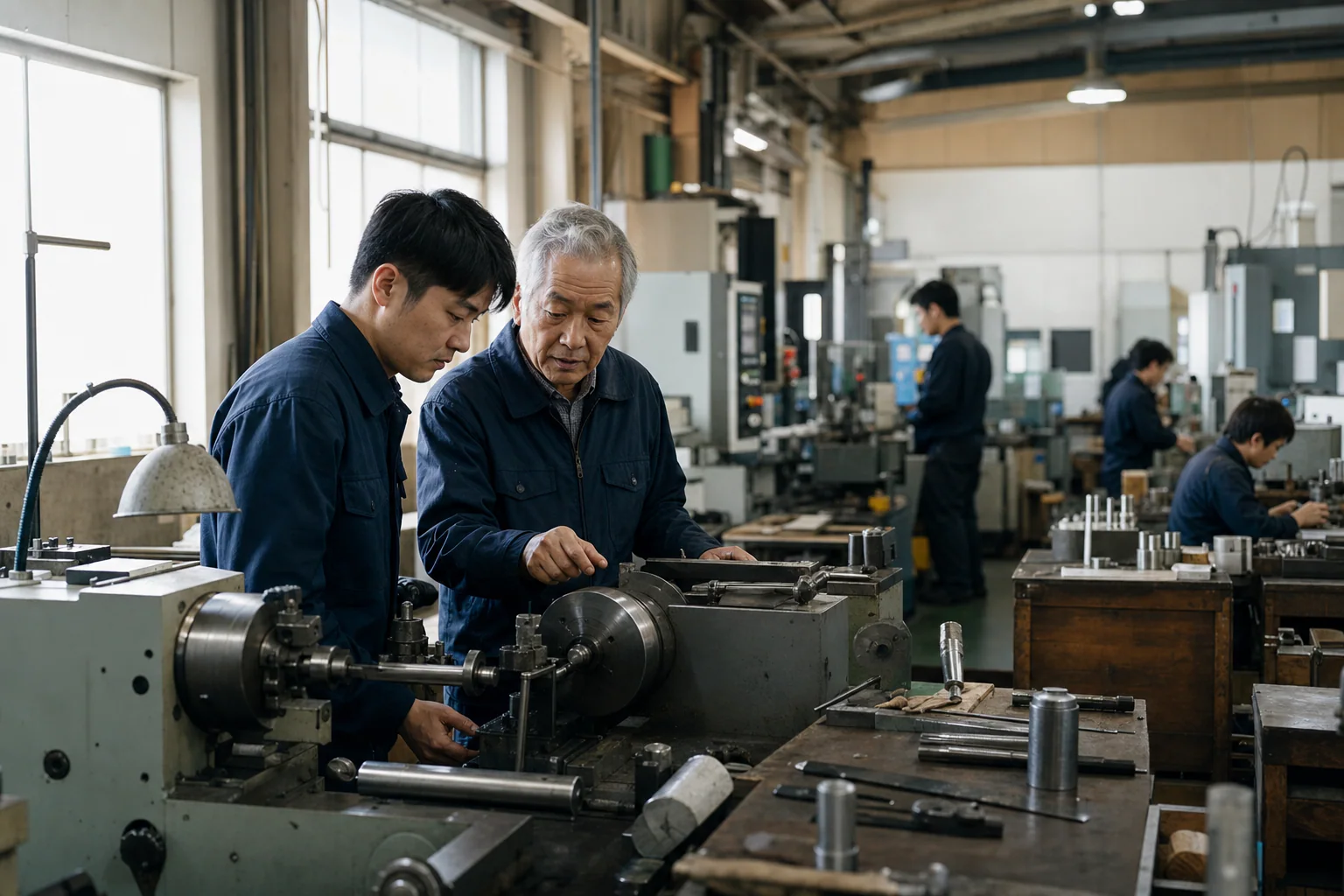
Japanese SME leaders and a cross-border advisor discussing the future of an operating business

Japan Desk · M&A Origination & Execution

Build in Japan. Partner with Japan. Acquire in Japan.

TVC connects international buyers, Japanese companies, and founder-led SMEs through local origination, bilingual transaction leadership, and the cultural judgment needed to move from first conversation to long-term value.

3Japan locations
3Strategic pathways
1Accountable cross-border desk
01 / Japan M&A thesis

The Japan opportunity

Japan’s next chapter is changing hands.

Behind Japan’s global brands is a vast economy of specialist SMEs—businesses built on engineering, service, reputation, and relationships.

As owners confront succession and companies pursue new capabilities, M&A is becoming part of the infrastructure for continuity and growth. The opportunity is substantial, but access depends on context, discretion, and a credible reason for the company to engage.

99.7%of Japanese enterprises are SMEs
68.8%of private-sector employees work in SMEs
3 pathsfamily, employee, or third-party succession
Definitions and figures follow Japan's 2025 SME policy guide. Market context is indicative—not a transaction forecast.

Source: Small and Medium Enterprise Agency, Japan — 2025 SME policy guide

02 / Choose your Japan path

One market. Different first moves.

Choose the route that serves the strategy.

An acquisition, partnership, and new entity solve different problems. Start with the outcome, then design the structure.

Acquire / Japan

Enter through a business that already belongs.

Acquire operating capability, customer access, specialist talent, technology, or a succession-ready platform—with local origination and a transaction process designed for both sides.
  • Platform or capability acquisition
  • Owner-led succession opportunity
  • Bilingual diligence and transaction execution
Explore this pathway
03 / Japanese SME M&A

Japanese SME M&A as a culture of continuity

In Japan, an acquisition is also a promise.

The strongest process respects both transaction logic and the human system around the company. These are not universal rules; they are practical questions that deserve explicit attention.

Japanese SME leaders considering continuity and future ownership

Principle 01

Continuity before disruption

A founder may be evaluating more than price: the future of employees, customers, suppliers, reputation, and a name built over decades.

Principle 02

Trust before access

Sensitive opportunities often emerge through patient, permission-based conversations. The quality of the introduction shapes the quality of the process.

Principle 03

Consensus before commitment

Decision-making can involve owners, management, family, lenders, and long-standing advisers. Alignment is a transaction workstream, not a courtesy.

Principle 04

Integration before Day One

Management continuity, reporting, communication, authority, and cultural translation should be designed while the agreement is still being negotiated.

Succession architecture

One company. Three possible successors.

Succession is not a single event. It is a choice about who will carry the company’s knowledge, responsibilities, and opportunity into its next chapter.

01

Family succession

Transfer leadership and ownership to the next generation while preparing governance and capability for the future.

02

Employee succession

Transition to trusted management or employees when leadership capacity and financing can support the handover.

03

Third-party succession

Use M&A to connect the company with an owner able to preserve its strengths and fund its next stage of growth.

Acquire in Japan

From investment thesis to Day One.

A disciplined acquisition process moves commercial logic, owner alignment, diligence, regulation, documentation, and integration forward together.

Scroll to explore
01

Acquisition journey

Define the thesis

Clarify the capability, market position, technology, talent, or customer access the acquisition must create.
01 / 08
02

Acquisition journey

Map the market

Segment sectors, regions, ownership profiles, and strategic adjacency before approaching individual companies.
02 / 08
03

Acquisition journey

Originate discreetly

Approach owners through controlled, culturally aware conversations rather than undifferentiated outreach.
03 / 08
04

Acquisition journey

Build owner trust

Understand the owner’s objectives, stakeholders, continuity expectations, and conditions for serious dialogue.
04 / 08
05

Acquisition journey

Validate fit

Test commercial logic, operating capability, valuation expectations, and the buyer’s ability to add value.
05 / 08
06

Acquisition journey

Diligence bilingually

Coordinate financial, tax, legal, commercial, operational, HR, technology, and regulatory review.
06 / 08
07

Acquisition journey

Structure the transaction

Align consideration, governance, warranties, management continuity, and closing conditions.
07 / 08
08

Acquisition journey

Prepare Day One

Turn the deal thesis into a practical integration plan with clear decisions, communication, and ownership.
08 / 08
04 / Local origination

How we source local opportunities

The best opportunities begin with permission, not a listing.

Databases show what has been published. Local conversations help reveal what could become possible—and what it will take to earn the right to explore it.

Step 01

Listen in-market

Local conversations reveal the owner’s real objective before a process becomes public.
What this createsGround-level context
Japanese and international management teams shaping a strategic partnership
Partnership / Joint businessBuild the relationship before the structure.

Partner with a Japanese company

Partnership is a strategy, not a compromise.

A structured partnership can validate a market, combine complementary capabilities, and build trust before a larger capital commitment. The right model depends on what each party must contribute and control.

01

Distribution alliance

Reach Japanese customers through a partner with channels, service capability, and market credibility.

02

Licensing

Bring technology, IP, brands, or know-how to market with explicit rights, obligations, and quality controls.

03

Technical collaboration

Combine specialist capabilities without immediately combining ownership.

04

Joint R&D

Share development goals, budgets, milestones, IP ownership, and commercialization rights.

05

Capital & business alliance

Connect minority ownership to a defined commercial and governance agenda.

06

Joint venture

Create a jointly owned platform with agreed control, resources, economics, and exit mechanics.

Reference: JETRO J-Bridge collaboration pathways

Joint venture governance

Build the JV before incorporating it.

The legal vehicle is only the container. A durable partnership needs explicit decisions about value, control, contribution, accountability, and exit.

01Shared purpose and measurable scope
02Capital commitments and future funding
03Board composition and management appointments
04Reserved decisions and delegated authority
05IP ownership, licensing, and data rights
06Operating plans, reporting, and audit access
07Deadlock, transfer, and exit mechanics
08Compliance and stakeholder communication

Company and entry structures

Six ways to create a presence in Japan.

Compare the operating logic first. Legal, tax, regulatory, and accounting consequences require advice based on your exact facts.

Swipe / scroll
RO

駐在員事務所

Representative office

Explore before operating
Legal position
Not a separate legal entity
Activity
Market research, liaison, information gathering
Cannot ordinarily conduct commercial sales activities in Japan.
BR

支店

Branch office

Operate as the foreign parent
Legal position
Extension of the overseas company
Activity
Commercial operations within registered scope
The foreign parent remains responsible for the branch’s obligations.
KK

株式会社

Kabushiki Kaisha

Build a formal Japan platform
Legal position
Separate Japanese legal entity
Activity
Full commercial operation
A familiar corporate form with structured governance and share ownership.
GK

合同会社

Godo Kaisha

Prioritize governance flexibility
Legal position
Separate Japanese legal entity
Activity
Full commercial operation
A limited-liability company form with flexible internal governance.
JV

合弁会社

Joint venture

Build with a Japanese partner
Legal position
Typically formed as a KK or GK
Activity
Defined shared commercial purpose
The entity form matters, but the shareholder agreement carries the operating logic.
M&A

企業買収

Acquisition

Enter through an operating business
Legal position
Acquire shares, assets, or a business
Activity
Continue and develop existing operations
Requires transaction, regulatory, integration, and stakeholder planning.

Structures vary by purpose and facts. Review current requirements before acting. Source: JETRO — types of operation in Japan

A contemporary Japan operating team preparing a new business platform
Establish / operate / govern

Establishment support

From incorporation to an operating business.

Formation is one milestone. A functioning Japan platform also needs people, banking, reporting, licenses, tax, governance, and clear coordination across specialist workstreams.

01

Market and feasibility

Define commercial objective, operating footprint, investment assumptions, and decision criteria.

02

Entity and governance

Compare representative office, branch, KK, GK, JV, and acquisition routes.

03

Regulatory screening

Identify foreign-investment, competition, licensing, and sector-specific questions early.

04

Registration and capital

Coordinate articles, ownership, officers, registered address, capital, and registration workstreams.

05

People and operations

Plan immigration, employment, payroll, social insurance, banking, accounting, and office setup.

06

Ongoing governance

Establish reporting, tax, statutory, compliance, and decision-making routines for the operating company.

Explore establishment support

Industry perspective

We learn the operating logic before we discuss value.

Every sector has its own sources of defensibility, diligence risk, stakeholder expectations, and integration priorities.

01

Precision manufacturing

Specialist processes, supplier positions, engineering talent, succession, and international capacity.

Explore industry
02

Technology & software

Recurring revenue, source-code and IP ownership, technical talent, customers, and localization.

Explore industry
03

Food & beverage

Brands, production standards, distribution, export potential, ingredients, and quality systems.

Explore industry
04

Healthcare & medical

Licensing, clinical and product risk, trust, reimbursement, data, and specialized talent.

Explore industry
05

Logistics & supply chain

Routes, fleets, warehousing, cold chain, service quality, and customer concentration.

Explore industry
06

Business services

Recurring relationships, professional talent, delivery systems, compliance, and cross-selling potential.

Explore industry

Japan-specific execution

Regulation is a workstream, not a final check.

Screen the transaction and operating model early. Requirements change with the investor, target, sector, structure, and current rules.

01

Foreign investment

Screen the investor, target activities, ownership structure, and applicable thresholds under Japan’s foreign-investment framework.

02

Competition and sector rules

Assess merger-control questions, business licenses, approvals, notifications, and industry-specific restrictions.

03

People, tax, and data

Coordinate employment, immigration, tax, social insurance, IP, privacy, and operating compliance with appropriate specialists.

Requirements depend on investor profile, transaction structure, target activities, applicable thresholds, and current rules. TVC coordinates Japan-specific legal, tax, regulatory, labor, and foreign-investment workstreams with appropriate licensed specialists.

MOF foreign-investment resources

Japan–ASEAN corridor

Two growth regions. One operating bridge.

We connect Japanese companies seeking production, talent, distribution, and growth abroad with ASEAN businesses seeking Japanese strategic partners, technology, and market access.

Japan → ASEANProduction · Talent · Distribution · Growth
ASEAN → JapanStrategic capital · Technology · Market access

Local Japan presence

Tokyo, Nagoya, and Osaka—three perspectives on one market.

Local presence helps us understand the different industrial, commercial, and owner communities that make up Japan’s mid-market.

01

Japan office

Tokyo

AM Building 7F, 2-5-3 ShinjukuShinjuku-ku, Tokyo 160-0022, Japan
02

Japan office

Nagoya

4F Meiekimori Building, 5-3-8 MeiekiNakamura-ku, Nagoya-shi, Aichi 450-0002, Japan
03

Japan office

Osaka

9F Toyosaki Izumi Building, 2-7-9 ToyosakiKita-ku, Osaka-shi, Osaka 531-0072, Japan

Begin with the objective

Your Japan strategy may begin with a company, a partner, or a blank sheet.

Tell us what you are trying to build. We will help you identify the right first move and the workstreams required to make it real.

Start a confidential conversation